Social Security at 62 is the earliest age you can claim retirement benefits in the United States. But if you start at 62, your monthly payment is permanently reduced compared to waiting until your full retirement age or age 70.
This guide explains how much Social Security you may get at 62, why the amount is lower, and how to compare this option with claiming later. If you are trying to decide between early income and higher monthly checks, this is one of the most important retirement decisions you will make.
Quick answer
- You can claim Social Security at 62, but your benefit is reduced permanently.
- If your full retirement age is 67, claiming at 62 may reduce your monthly payment by up to 30%.
- Claiming at 62 may make sense if you need income now, have health concerns, or want to protect savings.
How Much Social Security Will I Get at 62?
Your exact Social Security amount at 62 depends on your earnings history, your full retirement age by birth year, and your primary insurance amount (PIA).
In general, claiming at 62 reduces your benefit compared to claiming at full retirement age. For many retirees:
- If FRA is 66, the reduction is about 25%.
- If FRA is 67, the reduction may be up to 30%.
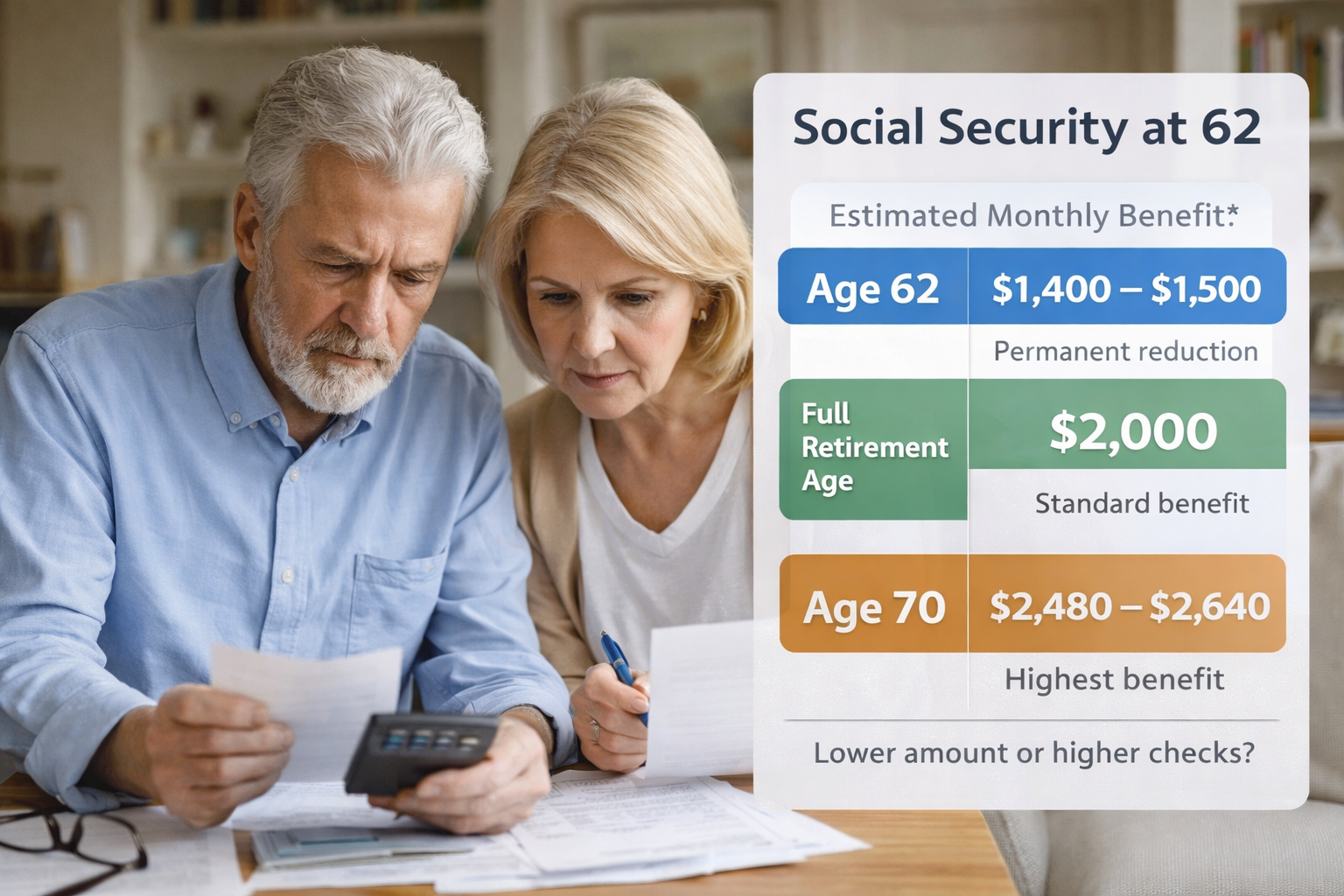
That means if your full benefit at FRA would have been $2,000 per month, your benefit at 62 could be closer to $1,400–$1,500 per month.
Why Is Social Security Lower at 62?
Social Security is lower at 62 because you are claiming benefits earlier than your full retirement age. The Social Security Administration applies a permanent reduction to account for the fact that you may collect payments for a longer period of time.
Important: Once you claim at 62, that lower monthly amount generally stays with you for life, apart from annual COLA increases.
Example: Social Security at 62 vs FRA vs 70
| Claiming Age | Estimated Monthly Benefit* | Key Tradeoff |
|---|---|---|
| 62 | $1,400–$1,500 | Income sooner, but permanently reduced |
| Full Retirement Age | $2,000 | Standard full benefit |
| 70 | $2,480–$2,640 | Highest monthly payment |
*Illustration example only. Actual amounts depend on your earnings record and FRA.
For a broader comparison, read: Social Security benefits by age: 62 vs 67 vs 70.
How to Estimate Your Social Security at 62
To estimate your Social Security at 62, start with your full retirement age benefit and then apply the early claiming reduction.
The easiest way to think about it is:
- Find your estimated full benefit.
- Confirm your full retirement age.
- Apply the reduction for claiming at 62.
If you want to understand the formula behind your benefit, see: How Social Security is calculated.
When Claiming Social Security at 62 Makes Sense
Claiming at 62 is not always a mistake. It may be a smart move if:
- You need income right away
- You have health issues or shorter life expectancy
- You want to reduce withdrawals from savings
- You are comfortable accepting a lower monthly benefit
For a full analysis of the pros and cons, read: What happens if you retire at 62?
When It May Be Better to Wait
Waiting beyond 62 may be better if:
- You expect to live a long time
- You have enough savings or income to delay
- You want a larger guaranteed monthly payment later
- You are planning around survivor benefits for a spouse
If you are deciding whether to wait, this guide will help: When should you claim Social Security benefits?
Break-Even Age: Is 62 Worth It?
One useful way to compare 62 with later claiming ages is break-even analysis. This tells you the age when waiting starts producing more total lifetime benefits than claiming early.
In many cases, the break-even point is somewhere in your late 70s or early 80s. If you expect to live beyond that, delaying may produce higher lifetime income.
Use this detailed guide: Social Security break-even age
FAQ: Social Security at 62
How much less do you get if you take Social Security at 62?
If your full retirement age is 67, claiming at 62 may reduce your benefit by up to 30%.
Can I work and collect Social Security at 62?
Yes, but if you are below full retirement age, the earnings test may temporarily reduce your benefits if you earn above the annual limit.
Is Social Security at 62 a good idea?
It depends on your health, cash flow needs, life expectancy, and whether you can afford to wait for a larger monthly benefit.
Final Thoughts
Social Security at 62 can provide income sooner, but the tradeoff is a permanently lower monthly benefit. For some retirees, that tradeoff is worth it. For others, waiting until full retirement age or 70 may be the better long-term strategy.
Next steps: Full retirement age → Benefits by age → Break-even analysis
Related Guides: